I’ve
been watching the US news and reading comments and articles and Facebook posts about the Trump/Kavanaugh
situation. I am deeply sad. I know SO MANY guys who are genuinely kind and loving, and generally fantastic. You are my
family, you are my friends, you married my friends and became my friends. I am so grateful for
you. But it’s become clear to me lately that many of you may not understand
that I actively limit my life to protect myself from men. These are choices I
have made. I am telling about a few so you know what they are and why I made them:
- I deliberately limit my activities to increase my feeling of safety. I have had several experiences in public where I’ve been accosted by men and no one around me did anything to stop it. I don’t want to experience that again. So. I generally don’t go out late in my neighbourhood (where I’m comfortable) or in the city (where I’m less comfortable). I don’t drink much in public (even with friends) because I am responsible for getting myself safely home – I’ve discovered not all friends can be relied on to assist with that. I bike most places because a) it’s less risky than walking or public transport when I’m coming home at night by myself (and b) fitness, c) I’m cheap :)).
- When I’m looking for apartments I will not live on the ground floor because that doesn’t feel safe. I chose my previous living arrangement here in Australia because it was on the back of a lot and not visible to the street, which made it OK to be on the ground and have big windows into my living space. Now I live on the 7th floor. (Also, with big windows which no one can look in. The view is great.)
- I have been in a relationship where a guy (who is a generally good guy) explained to me that a woman’s job was to say no to sex, and the guy’s job was to persuade her. I believed him. Because I have family members who have explained to me (and lived as if) wives belong to their husbands, (basically because we are property, the Bible says so) and we should obey them. It’s our job. I still love that guy, and I love these family members. They are genuinely kind-hearted, beautiful people. However, I also know that I fundamentally cannot survive in that kind of relationship. (I tried it.) So for most of my life, I’ve been single, because even though I really enjoy companionship and sex, I’m not interested in a relationship where my non-consent is seen as some kind of challenge, or I am viewed (even unconsciously) as property. Apparently, there are other kinds of relationships. I’m working on believing that idea.
In
thinking about the choices I have made, why I have made them, and the larger
issues that (so far) mean I need to keep many of them, I started to wonder about how I could do
something about it. And here’s what occurred to me.
When
I teach, I start my classes with public agreements. Someone recently categorised
these as norms, but they are not. Norms are unconscious beliefs. Public
agreements are visible and consciously agreed upon by a group. Like norms, they
determine the kind of behavior/activity that the group will tolerate, and what
it will not. However, because they are public, and we start the term with them,
then no one in the group has to wonder if someone is behaving badly – it’s
already been agreed upon. It’s identified and identifiable. This means it’s
much easier for anyone in the group to call bad behavior when they see it,
because they have that agreement (and the group) at their back. I find this solves
a lot of problems before they start; the rules of engagement are clear for
everyone.
An example: the squirrel rule is a public agreement I use in classes
and meetings. If someone (including me) takes off on a tangent, anyone can say “Squirrel!”
(or “Squirrel?”) to invite the person to explain how what he/she/I am talking
about is related to the topic at hand, or confess he/she/I was squirrelling and
get back on track. It is practically magical how this public agreement works in
all kinds of settings – because we agreed upon it at the start of the group's being together. After almost 6 years in
Australia, if I forget to start with it, my past students squirrel me (and each
other) anyway, and then explain it to anyone who doesn’t know about it. The squirrel
has taken on a life of its own. As they do.
So
here’s a “what if.” (And this is mostly addressed to guys because let’s be
clear: you have power.) What if the guys who read this sat down with their guy friends
(in Australia: mates) and created a public agreement about how women should be
treated? What if you asked women you know what that agreement should look like? What
would they tell you? What if you and the women you know picked a code word to
alert each other when that public agreement was at risk? What if you (guys)
used it and acted on that public agreement together – for instance, a) when you
see your friends getting too close to bad choices, or b) if you see other guys behaving
badly? What if you acted to short circuit that bad behaviour whenever you saw
it? What if you used humor, distraction, or just told them it wasn’t OK? What
if you explained the agreement to them, and the word, so they could be in on
it? What if you found the “Squirrel” equivalent for these kinds of situations?
I
would like to live in a world created by answers to those what ifs. :)
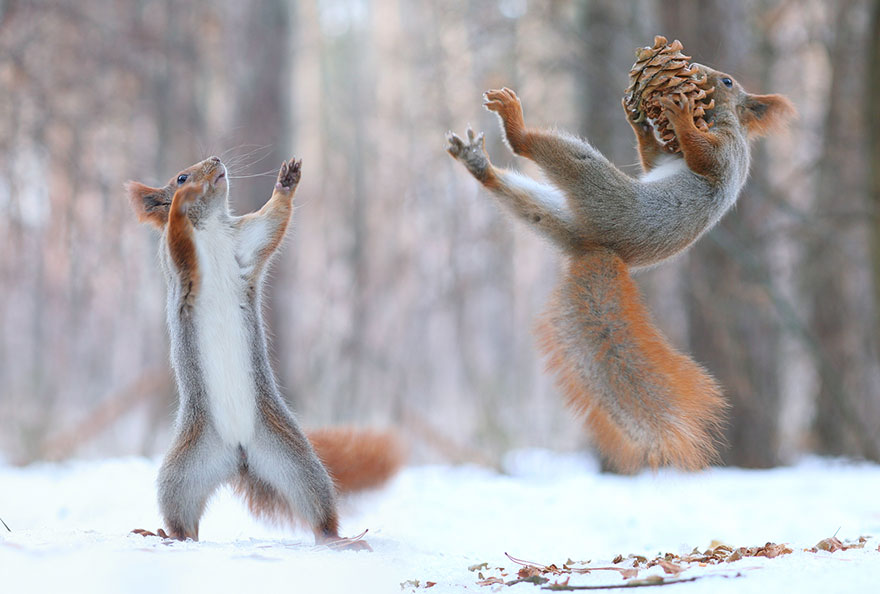
As your reward for making it to the end of this post, here's my favorite squirrel photo (by Vadim Trunov):
Want more?
...on Public Agreements? See Kegan and Lahey, How the Way We Talk Can Change the Way We Work. Thanks to Prof. Mary Hess for suggesting
Lindean and I read it back in the day.
...on why a
Squirrel? See the movie Up! (or just this bit). And thanks to Lynn Lee at Western who used it
in conversation this way and gave me the idea for the public agreement.
